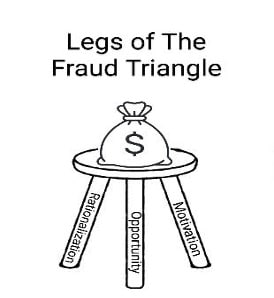
In the 1950’s in a dissertation at Indiana University, Donald R. Cressey and Edwin H. Sutherland first proposed the idea of what is now infamously known as The Fraud Triangle. Cressey was interviewing embezzlers, who he referred to as “trust violators”, trying to understand the circumstances that led them to first breaking that trust. His final hypothesis was condensed down to the three elements that he believed must be present for fraud to occur: Motivation, Opportunity, and Rationalization.
- Motivation: a perceived pressure, generally financial pressure, that makes the Trust Violator feel they must commit the fraud.
- Opportunity: because of the trust placed in them, the Trust Violator has the perceived opportunity to commit the fraud, and they feel they can do it without getting caught.
- Rationalization: embezzlers generally do not believe themselves to be criminals, therefore their rationalization must occur prior to the theft and is often part of the motivation.
 COVID-19 presented many people with the right set of circumstances to commit fraud with many employees newly working from home and distracted. For example, let’s say Suzie worked for A OK Company as a secretary and during COVID-19 she was sent to work from home (as with everyone else in the company), but her kids and husband were home with her and it often felt like barely controlled chaos. Suzie knew that she was expected to work 40 hours a week, but no one was there to see if she did, and she needed to make sure her kids were working on their schoolwork from home as well. Suzie had the perceived pressure, knowing that she would be questioned if she didn’t record at least 40 hours each week and she still needed the money from her 40 hour per week payroll. The opportunity, as long as her remote working status said she was available, no one could really tell if she was working the whole time or not. And the Rationalization, wasn’t her employer being rather unreasonable to expect her to be able to work 40 hours a week from home with her kids and husband home? Suzie decided to commit a falsified hours scheme while working from home.
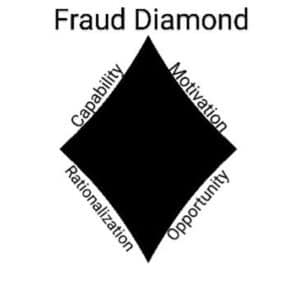 Over half a century later, in 2004, David T. Wolfe and Dana R. Hermanson published a paper for Kennesaw State University called “The Fraud Diamond: Considering the Four Elements of Fraud”. In this paper they expound on the idea of the Fraud Triangle and proposed adding a fourth element to it: Capability. Capability in this case is the idea of being the right person, in the right place, at the right time to be able to perpetrate this specific fraud. While there is definite overlap between the four elements, the significant addition to the Fraud Diamond is assessing the capability to commit the fraud completely independently from the other risks.
In the example of Suzie above, she had the capability to perpetrate this specific fraud because she input her own time into the timekeeping system and her . She could spend the majority of her work week at the circus, but as long as 40 hours were input into the system with a plausible description, she would be paid for them.
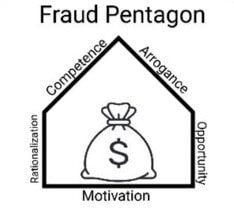 Half a decade after the idea of The Fraud Diamond was introduced, the term The Fraud Pentagon was coined by Jonathan Marks in conjunction with CPA firm Crowe Horwarth LLP in 2010. This theory expands again upon the original idea of the Fraud Triangle by adding Competence and Arrogance. Competence, in this case, is given almost the same definition as capability described in the Fraud Diamond, the perpetrator’s ability to commit the fraud. The new element here comes in the form of arrogance, the attitude of superiority and entitlement or greed, the perpetrators’ belief that the internal controls in place do not apply to them.
Back to Suzie’s example, her competence is the same as her capability discussed above, but her arrogance would come from the idea that even if she didn’t work the entire 40 hours she should be entitled to the pay because she was good at her job and she deserved it. She knew that she wasn’t supposed to input more hours than she worked, however with COVID-19 she felt that rule certainly shouldn’t still apply. Arrogance helps explain why Suzie decided to commit fraud, but Ashley, another secretary at the same company with the same set of circumstances did not commit fraud.
The question is, did we improve upon the Fraud Triangle? Or just muddy the waters? Is a Fraud Hexagon next? It is easy to see how losing even one leg of the Fraud Triangle would cause the entire scheme to collapse, but the more we add to it, the more convoluted it becomes. Cressey’s original hypothesis was intended to address “occupational fraud”, an internal fraud committed by someone within the organization taking advantage of their employment for personal benefit. He intentionally excluded from his research people who took jobs for the purpose of stealing. By adding a capability, beyond just opportunity, and an arrogance beyond just rationalization, are we taking this further than Cressey had ever intended, to external or predatory fraud?
It is also important to note that “the Fraud Triangle is a useful tool to help us understand why and how people commit fraud, but it’s not a scientific theory.” as John D. Gill says in his article The Fraud Triangle on Trial. Especially if you are taking a fraud case to court, the judge isn’t likely to agree with you based solely on the grounds that the three legs of the fraud triangle are present. Just because someone can, doesn’t mean that they will commit fraud. It’s impossible to know why two people in “almost” the exact same situation would make different choices. When dealing with fraud, you must remember that each case is as unique as the embezzler themselves and that uniqueness is why two people are never in the exact same situation. Although the fraud shapes provide a useful framework to help with fraud analysis, they do not prove fraud on their own.
The partners at Capstone Forensic Group all hold the CFE (Certified Fraud Examiner) credential and are happy to help review your evidence and show if elements of fraud are present in your case.
We are a principled firm with extensive knowledge of forensic accounting, fraud investigation, business valuation, and expert witness services. Contact our team today with your information to begin a conversation with our team.